
It’s 2012, and I’m on my way to Austria to see a friend. Almost the entire journey is ahead of me, because I’ve only just staggered out of my door with my over-full rucksack (I haven’t yet learned the skill of packing a bag effectively) and I’m a ten-minute walk away from the bus stop that will take me to the train station and then the airport.
What follows is a personal experience that I would never wish upon anyone else – but I know for a fact that thousands of people go through every year.
As I hoof it down the street, I’m cursing myself for not quite giving myself enough time to double-check everything. This must be one of those laws of the universe, I think to myself: the time you give yourself to finish packing and leave the house is always slightly less than the time you actually have! (This is not true – you just have to pack your bags the day before, but it’ll take me years to learn this lesson.)
Yet I think I have all the important stuff. Don’t I? Wallet: check. Phone: check. Printed-out boarding pass for the flight: obviously, duh…
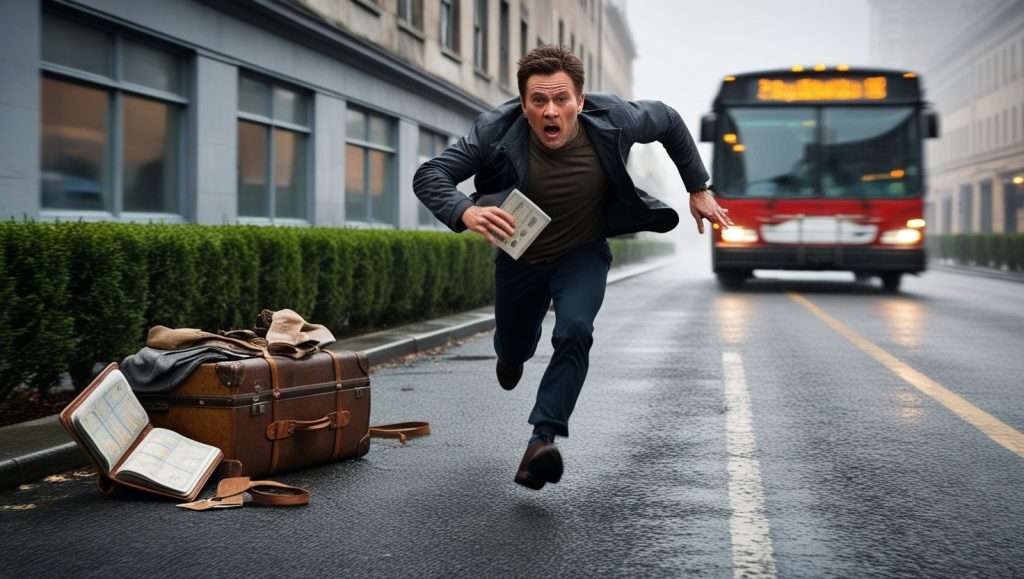
And so it’s at the bus stop, when my heart-rate slows enough for me to regain my wits, that I remember my passport is still on my bedside table.
I’m glad to say this story has a happy ending. Leaving my rucksack in a hedge, I sprint back, grab my passport, return to find I’ve missed the bus, but manage to hitch a ride with a stranger just in time to catch the right train. Except – all that stress, all that self-recrimination, just because I forgot perhaps the most important item you need when you’re travelling abroad. How could you do this, Mike? How?
Yet it’s so common (up to 8% of all British men fall prey to a forgotten passport, according to this survey).
What’s the best way around this?
In her book How To Change: The Science Of Getting Where You Are To Where You Want To Be, Katy Milkman (James. G. Dinan Professor at the Wharton School of the University of Pennsylvania, and host of the always-insightful podcast Choiceology) notes that our ability to remind ourselves to do things in advance of the time we need to do them is appallingly untrustworthy.
If you’ve ever said to yourself or someone else “Oh dear, sorry, this is so embarrassing, I’m so forgetful” – well, you’re stating the obvious. Of course you’re forgetful: as a human, you’re made that way. If we didn’t forget huge amounts of things every single day, our minds would overload in no time. It’s as necessary to our ability to function as the domestic chores that keep our homes ticking along, like washing the dirty crockery that piles up in our sink.
This means it’s not something to be ashamed of, but something to manage. It’s all about making sure you’re forgetting the right things (eg. what a waste of time reading that tabloid news story was, or how much our big toe hurt when we stubbed it coming out of the shower) and retaining the actually-worth-remembering stuff, like meeting appointments, and anniversaries, and the PIN number for your credit card, and so on.
Only thing is: the important stuff is hard to remember too! We can’t just rely on our memory to rank this stuff in a sensible way. We’re too overloaded with raw information, too distracted and just too naturally forgetful by default, and our minds are less like neatly-indexed filing cabinets and more like that warehouse of endless rows of unmarked crates at the end of Raiders Of The Lost Ark.
Milkman cites a study from 2004 by John Austin, Sigurdur Oli Sigurdsson and Yonata Shpak Rubin, running outside a hotel & casino. 433 participants (who didn’t know about the experiment) were reminded to buckle their seat-belts as they came to collect their cars. The three test groups were:
– business as usual (no reminder was given to them)…
– a reminder given by the parking attendant, around 3-5 minutes before the drivers climbed into their cars…
– a reminder given at the moment the driver was clambering into the driver’s seat.
In the business-as-usual case, around 55% of drivers buckled up before they drove away. Just over half. Less than stellar.
So maybe you’d expect the other two groups, where they’re being actively reminded, would be a significant improvement on this?
In fact, the group reminded just a few minutes before driving away … had pretty much the same rate of buckling up, around 55%! Basically no change from the control group. That particular reminder had proven useless.
But the ones reminded at the time that reminder was required? Their success rate shot up to 80%.
I am sure a little of this could be down to not wanting to look like a criminal (or an idiot) in front of someone who might frown at you for driving without a seatbelt, but – was it mainly just a much more effective time to remind someone? Milkman’s further research suggested it absolutely was.
So here’s one way to remember your passport, and everything else. You don’t just make normal reminders for yourself, in that to-do-list manner we all do, promising ourselves that every morning we’ll refresh our memory of what to do for the rest of the day, and that should be enough if we’ve got our act together. Nope! That’s putting too much weight on our unreliable memories.
Instead, what you need is to be reminded to do something at the precise moment you need to take action on it.
Maybe this is using an app that flashed a notification onto your phone’s or tablet’s screen at just the right moment. Or maybe, if you compulsively live out of your email Inbox like I do, you can send a timed email to yourself, designed to arrive just when you need it.
Or maybe you can buy a dozen alarm clocks and litter your house with them, slowly turning yourself into a trembling nervous wreck! (Okay, maybe don’t do this.)
In my case, the solution is simple. The very last act I will perform before going on vacation will be to open my front door – so that is where I need to stick a big piece of paper saying “MIKE!!! Are you sure you have your phone, keys, wallet, boarding pass and passport? CHECK NOW!”
By pinpointing the moment when you need to remember something, and tailoring your reminder so it’s going to be completely unavoidable in that exact moment, you won’t need to have a perfect memory – you can just remain you, bumbling along, doing your best until difficult circumstances, and making entirely understandable blunders – but in a way you’ve expertly anticipated, so they never have a chance to ruin everything.
I hope the rest of your trip is unforgettable.