
It’s 2007, and I’ve just arrived at my accommodation on the Greek island of Naxos.
I’m exhausted to the point of delirium (this may explain what happens next) and I’m suffering the early stages of the worst sunburn of my life – which will end with 24 feverish, heat-exhausted hours in a darkened hotel room in Crete where I do nothing but knock back litres of water and slather moisturiser over myself.
But that’s in the future. Right now, my host has just presented me with a Greek coffee: this is where they leave the grains in, & they sink to the bottom of the cup to form a powerful sludge that continues to pump out caffeine, creating something between drinking a beverage and being kicked by a moose.
I thank her, sit by the window and sip my coffee until the caffeine pulses, tsunami-like, through my bloodstream – and with my now-overstimulated senses, I suddenly notice the shelf.
I’m a sucker for ogling people’s book-shelves. You can tell so much about them as people. (If you’re going to be judgemental about folk, at least do it properly. Go for the brain!) But this nosy habit is either difficult or impossible when you go travelling. You don’t recognise any of the books, and you might not be able to read the language. Zero opportunities for making small-minded assumptions!
This shelf is no different. I can’t read any of the books on it. But who cares, because look at the colour of that shelf!!!!
This is my first opportunity to see Cycladic Blue up close – that luminous, piercing pale shade of sky-blue that seems lit from within, which you’ll find all across the Greek island chain of the Cyclades.
However it first came about – legend has it that Frederica of Hanover, Queen Consort of Greece from 1947 to 1964, gave it a big push at one point – someone realised blue would be a terrific compliment to the whitewashing that’s been required by law across Greece from 1938 onwards. (At this time, limestone whitewashing was seen as a good way to combat cholera).
If the walls of every house were white, and the details were picked out in sky-blue, every town and village would be the colours of the Greek flag! What a boost to national pride that would be – as well as looking profoundly easy on the eyes.
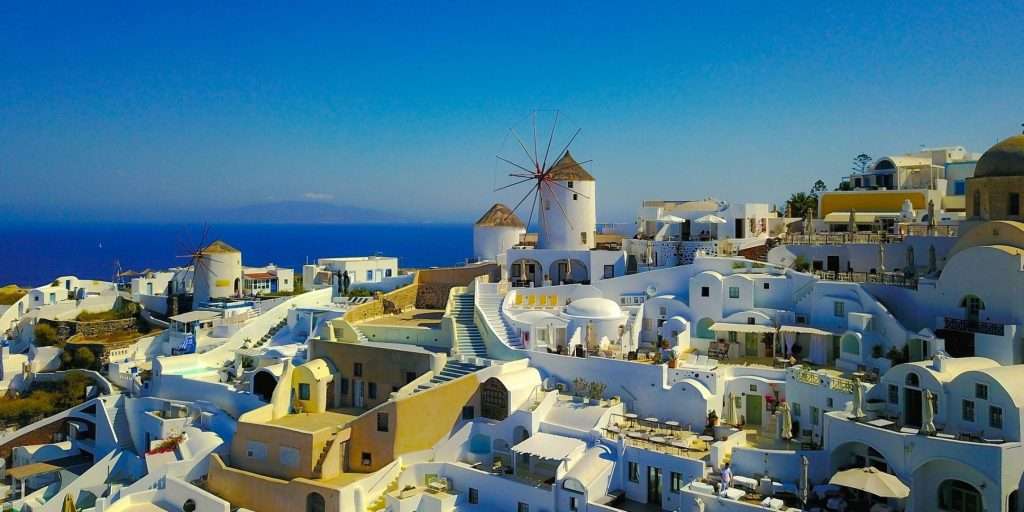
This smartly complements the practical benefits: white keeps building interiors cool (more on that in a minute), while a very common household cleaning agent called loulaki is (or was) the easiest way to create a second colour, since its solution reacts with limestone plaster to turn blue.
But forget practicality. It’s just gorgeous. The closest to it that I’ve seen anywhere else is when I visited Chefchaouen in Morocco, with its famously photogenic blue-washed interior. Check out Canadian writer Jodi Ettenberg’s photoessay from her own visit to see what I mean. But in my mind there’s something special in the Greek islands version. What? I don’t quite know, even though some part of my mind seems absolutely certain of it.
But turning the outsides of buildings a dazzling shade of white might not just be aesthetically pleasing – it might be the best thing for your heating bills, the local economy and ultimately the state of the planet.
The most obvious reason that many buildings in the Mediterranean are blazingly white is that it helps keep the heat off in a way that’s affordable to everyone. (Yes, there are now more sophisticated methods at a higher price, but if a technique’s only available to the wealthy, how fair is that, and since those wealthy only live in a very small number of all the occupied buildings in the world, how effective is that? Isn’t this supposed to be about including everyone?)
Generally speaking, the darker the material, the more it absorbs heat. This is already a problem in many cities, and with the world warming up as it’s doing right now, it’s only going to get worse.
For example, roads. Fresh asphalt only reflects around 5% of the sunlight hitting it, so it can get up a shoe-melting 50 degrees hotter than the surrounding air temperature.
Concrete, estimated to be the most widely-used substance on the planet apart from water, is a problem in all sorts of ways, but one is how dull it is, optically speaking. It dominates our cities and it absolutely guzzles heat, helping create what are now called urban heat islands – settlements that are noticeably hotter than the surrounding countryside.
(And to be clear, this isn’t blaming concrete as such – it’s transformed a lot of lives for the better, simply because it’s empowered billions of people to acquire cheap homes for themselves. Concrete is not innately “bad” in this regard – but it certainly causes a lot of environmental problems.)
The wider problem is rising global temperatures, and there’s plenty that should be done about that, but in terms of alleviating the symptoms in cities, speaking very broadly, there’s two things in particular that seem to work really well: planting loads of trees, and painting all those concrete surfaces a different colour.
For example, in 2017 the western Indian city of Ahmedabad ran a pilot scheme where 3,000 rooftops were painted with a mixture of white lime and a reflective coating. This cooled the buildings underneath by between 2 and 5 degrees Celsius. Something similar is happening with New York’s tar roofs, under the CoolRoofs programme – and Los Angeles has coated some of its streets in a light grey paint. It helps, and it works.
But – how white can white get? Or rather: what’s the maximum possible reflectivity of white paint?
A team at Purdue University in Indiana has been experimenting with different compounds that absorb less UV light than usual paint materials, and in 2021, they created a paint that reflects 98.1% of all the sunlight landing on it – which means it could cool the surfaces it’s painted upon below the ambient temperature, without aircon. Pretty spectacular!
The only downside to this is that all that reflected light has to go somewhere – meaning that you’d need a strong pair of sunglasses to walk through those streets on a sunny day. So how about less reflective colours that deliberately absorb heat – then process it into an energy source? This seems a very fruitful avenue of research, and I’m sure solar panels are the uppermost tip of the iceberg here.
But here’s a wild idea from the fringes of modern colour science.
There are two ways to generate a colour in a surface: using a pigment (which is generally what we call “colour”), or by changing the way that light interacts with that surface, like the way a pearl or a soap bubble has that incredible multicoloured sheen that keeps changing as the light hits it from a different angle.
It turns out that the latter kind, called structural colour, can now be engineered using surfaces that can be deformed according to their temperature. Which means they could in theory be triggered by incoming sunlight! As soon as sunlight hits the surface, it changes its structural colour (and therefore its ability to reflect or absorb heat) in response to the intensity of that light.
At some point in the future, this could be an incredibly useful thing for the outsides of buildings for heat regulation. Just imagine it – on a really hot and sunny day, the outside of your home brightens up to reflect more heat away and keep the indoors a bit cooler, like the white-painted walls of homes in the islands of Greece – and on a bitterly cold day, it darkens to absorb as much incoming sunlight as possible. Maybe even instantly, in response to the sun coming out from behind a cloud. Imagine seeing a whole street doing that, or a city, in response to a sunbeam. Wouldn’t that be trippy? (Maybe too trippy?)
But enough of the speculation. The dazzling beauty of Greek island architecture is a solid fact, and it’ll lift anyone’s spirits – and if it’s also a glimpse of a brighter future, that’s something for future generations. Why not go enjoy what’s already an unmissable marvel for the senses right now?
Join Wheel & Anchor in April 2025 for a trip to Naxos, Paros and other islands of Greece on our island-hopping adventure. We’ll take local ferries and stay at least 3 nights for each stop to really see the islands that most cruise passengers only catch a glimpse of. Get the details here.