
Can paper maps make us better human beings?
Thanks to the astounding boom in GPS-assisted mapping gadgets, we can instantly know exactly where we are in the world to within a few metres, told by a machine that does all the work for us. A sign of progress if ever there was one, right? Smart travel is all about embracing new technology, and we’d have to be idiots to ignore the benefits of online mapping software – so should that be the standard for getting around, surely? Does that therefore mean we’ll be tossing our “old-school” paper offline maps in the bin because we don’t have a use for them anymore?
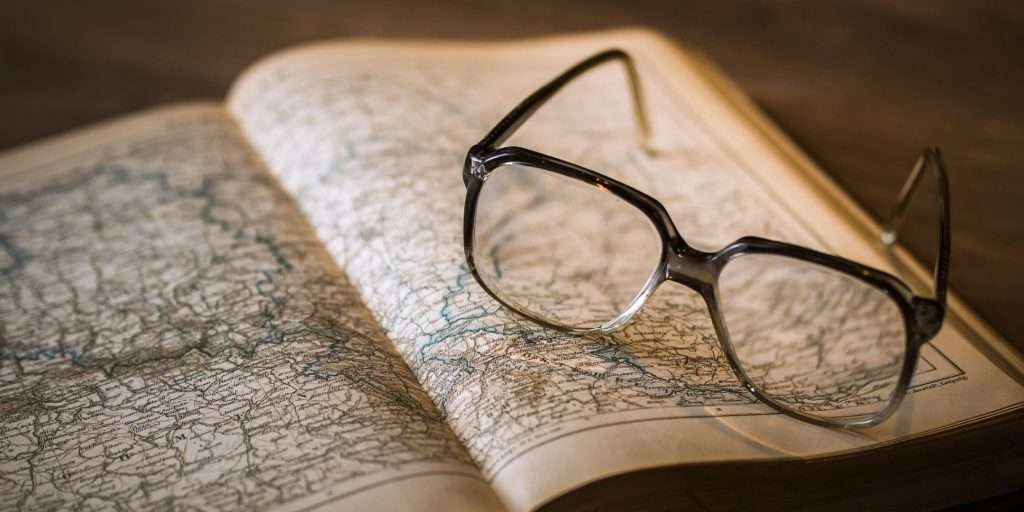
Here are 7 reasons why that might be a really bad idea.
1. MAPS ARE SELECTIVE
If geography is prose, maps are iconography.
As an archaeology student on excavations in the UK, I resented – no, I hated drawing archaeological features. We were taking heaps of photos, so why did we have to draw everything as well?
The answer is simple: archaeology isn’t just about gathering data, it’s about interpreting it. A photograph captures pretty much everything. Even in the hands of a pro, a camera is a device designed to capture the bulk of the light hitting it in one gulp. In contrast, a drawing selects. It sifts through the raw data to emphasize, highlight and ultimately present an argument constructed with skill. And it’s the same with maps.
2. MAPS NEED TO BE READ
You know the argument that Google search is making us stupid? How about cutting & pasting that argument into the realm of digital mapping?
Is this generation the last that will truly know how to read a map? The President of the British Cartographic Society has already expressed her concern — and since map-reading is a mental exercise, do we run the risk of dumbing down our brains by relying on machines to tell us where in the world we are?
3. MAPS ARE BEAUTIFUL
A year or so back, I visited the British Museum in London while an exhibition was running. The topic? The History Of Maps. Laid out in glass cases were some of the world’s most famous cartographic marvels — some impossibly complicated, as intricate as illuminated manuscripts, some riots of colour to the point of being garish – and all of them beautiful.
Maps aren’t just useful and educational. They’re useful, educational art.
4. MAPS ARE FUN
How about a London Underground style guide to France’s wine regions? And hey, when was the last time Google Earth was this much fun?
‘Nuff said.
5. MAPS ARE PROPAGANDA
Visit the divided Mediterranean island of Cyprus and you’ll notice a curious thing: the maps show different things, depending on where you bought them. For the last half-century, the EU-recognised Republic of Cyprus in the south, and the Turkish-occupied north of the island have been engaged in a cold war of naming conventions. Take the capital. A Republic-bought map will probably call it Lefkosia, its name during early Hellenic times – but pick up a map in the Turkish side and it’s called Nicosia, the name given to it by 12th-Century Lusignan crusaders. Two names, one place — and scale that down to villages and streets and you have a very confusing situation, especially when your map doesn’t reflect the names on street signs…
Maps are a human attempt to remodel reality — and in doing so, they tell a story about the people behind them. They’re cultural archaeology. Pick up a map in another country, and you’re holding something that reflects the way the inhabitants of that country see themselves. In other words, exactly the kind of insight a traveller is searching for.
6. MAPS HELP YOU CONNECT WITH PEOPLE
One of the most basic connections a human being can make with another is to ask for directions. It’s a staple technique for breaking the ice when you travel. (“Excuse me — where am I on here?”) And it’s harder to do that with a digital map – not that you would, of course, because a digital map will probably tell you exactly where you are.
And in doing so, it’ll prevent you making new friends.
No fun at all.
7. PAPER MAPS ARE OFFLINE
Oh, the hypocrisy of arguing against digital products on a website. But we’ve all felt “gadget block” — the feeling of being distanced from the world by a mechanical middle-man. And when digital maps are running on devices that connect you with a world of online distractions – well, you’re doomed. (That’s why productivity-honing services like StayFocusd are so popular). Do you really want to ditch your adventurous plans for the day because you’re stuck on a level of Plants vs Zombies 2?
For all these reasons and at least a dozen more, I think paper maps still have a role to play in the 21st Century – and wherever I go, I’m stuffing one into the depths of my rucksack for emergencies, or just for the sheer thrill of opening one up and seeing how it fits my surroundings…
What about you? Do you still use paper maps?