
In 2008 on the south coast of England, Weymouth resident Jane Barrett opened a letter.
The address on the front was that of the guesthouse she ran – Basil Towers – which was presumably why it had been shoved through her letterbox. But, confusingly, the addressee was a stranger’s name, a Mr Percy Bateman:
“When I first looked at it, I wondered why I’d been sent this tiny envelope. Then I looked closer and spotted the date…I couldn’t believe it.”
It read: “Dear Percy. Many thanks for the invitation, be delighted. See you on the 26th December. Regards Buffy.”
The letter was postmarked November 29th, 1919 – and also included a compliments card bearing the names of Mr and Mrs Percival Bateman and Grace Emmie Stewart, and a much more recent note from the Royal Mail apologising for the delay and for any damage that may had occurred to the item while it was in their care over the last 89 years (!).
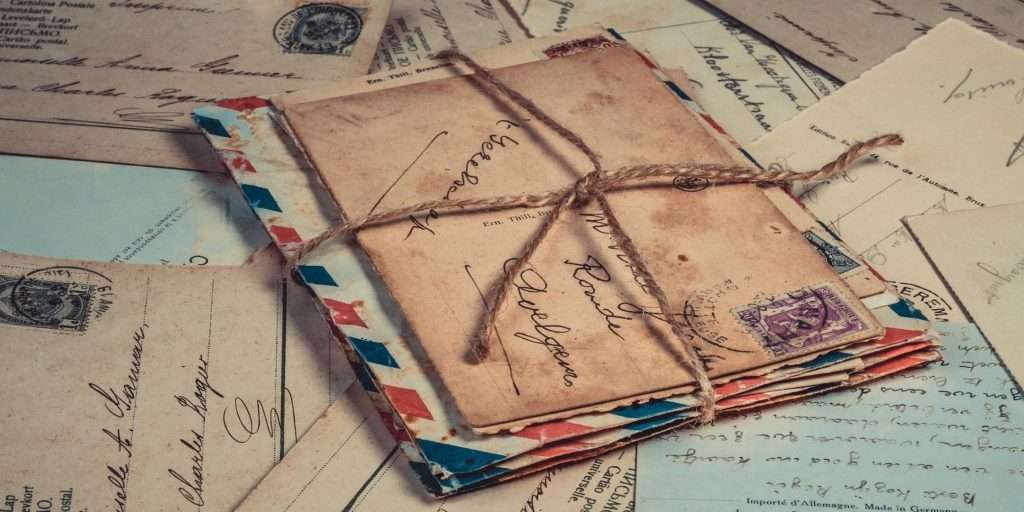
After issuing a public appeal for answers, Mrs Barrett was contacted by Mr Bateman’s now-85-year-old daughter Stella, who revealed the real name of “Buffy” was Charles Babbington, a friend of Percy since they served together in the Royal Navy.
It seems that Percy and his girlfriend Grace – later his wife & mother of their two daughters – were hosting a Boxing Day gathering at their home at 22 Abbotsbury Road, Weymouth, and would Charles like to come along? (You can imagine the breathless tone here: oh *do* say yes, Buffy.)
It’s unknown if the reply reached Percy by any other means, because it certainly didn’t by this route. As for the Batemans, they temporarily moved to London in the 1920s because of Percy’s position as an armament supply officer, then retired to Weymouth accompanied by Stella – and that’s where Mr Bateman died, aged 72, in the 1960s.
And in all that time, the length of at least one richly-lived human life, that letter remained almost frozen – not lost, as it turned out, but moving so slowly towards its destination that almost a century would pass until it arrived in a place filled with people who had forgotten it existed.
Last week in the Wheel & Anchor newsletter, Gordon wrote about the delightfully time-bending power of sending a picture postcard to the folks back home::
“It’s the postcard that matters. Because of our respective postal systems, the cards tend to arrive at their Canadian destinations in about three weeks, sometimes a little longer.
And that’s the magic right there. The time lapse. By three weeks out, we’ve moved on with our lives, told our stories, given out our souvenirs as gifts, polished our memories into the couple of little smooth pebbles we’ve put away in our pocket. We’re thinking about the next trip, or the kids, or the grandkids, or the snow. We have left what I call the travel bubble, that lovely little airy space we inhabit when we’re travelling, but also as we’re planning our trips, and in the days and sometimes week or so after we return. I know some people like to extend the planning process for their trips to live in the bubble a little longer. I love that. And what the postcard does, whether it arrives at your door, or at someone else’s who then of course messages you to tell you they got it, is it lets you pop right back into that bubble.”
But what about all the paper correspondences that are so delayed that when they reach their destination, it’s become part of another world entirely?
Take the case of 18-year-old William (“Bill) Myler Caldwell, who sent a postcard home from his placement in the British Royal Navy during his first week of training. He wrote:
“Dear Uncle Fred, Well here I am in blue at last. I did not think it would be like this, you don’t get much time for yourself do you but I like it alright. I will write a letter to you all when I get half a chance so will you hold on a bit. I have 19 weeks here yet. Give my love to everyone. Love Bill.”
He posted it in 1943 – and on the 19th February 2021, it finally got pushed through the letterbox of Bill’s family home in Liverpool, long after his family had passed away, and a quarter of a century after Bill himself had died of cancer.
“The course in Plymouth was 20 weeks long, and afterwards Mr Caldwell went to the front line, sweeping the beaches before the D-Day landings and being on the first British boat into Nagasaki after the Americans dropped the atomic bombs on Japan. Meanwhile, the house has remained in the family and is currently owned by Mr Caldwell’s nephew Dan whose stepson Jack Elomaa is living there.
Mr Elomaa said that he noticed the postcard sticking through the letterbox on Friday and, knowing that the house had always been in the family, alerted his stepfather. Dan immediately realised the significance and sent a picture to his cousins, Mrs Eales and her five siblings.”
Incredibly, though, that’s not the world record for these things – which arrived at the Swansea Building Society in Wales in August 2024, addressed to a Miss Lydia Davies at 11 Cradock Street – the current site of the Building Society, but formerly a row of houses.
How formerly? The postcard was dated August 23rd, 1903.
What I most like about this story comes from archivist Andrew Dulley, who said the following to Sheena Goodyear at CBC Radio:
“The thing that I’m finding odd, in a way, is that there’s nothing quintessentially remarkable about the postcard itself,” he said. “It’s the sort of thing people send to each other. It might as well be a text message nowadays…”
Once the card’s writer and recipient were tracked down, their descendants – four cousins, most of whom didn’t know each other existed – met for the first time at the West Glamorgan Archives in Swansea.
For 121 years, this communication had been working its way incredibly slowly through time and space – and what it delivered to the future of humanity was the distinctly non-epic message “Dear L. I could not, it was impossible to get the pair of these. I am so sorry, but I hope you are enjoying yourself at home.”
That’s the thing about postcards. They’re never meant to become part of the world historical record, broadcasting great events to the masses in an authoritative tone, and written with a sense of the eyes of a huge, rapt audience upon them, which is the self-conscious feeling that fuels a lot of social media posts. They’re not meant for any of that. They’re just one person, saying something small and intimate and thoughtfully heartfelt, to someone else, in a way that tells the recipient that the sender was thinking of them, even when life was at its most distracting (say, when they were travelling), with the thrill of being a physical object that’s taken a great journey of its own.
A travel postcard is the opposite of urgent, and the height of being ‘analogue’ and human, because of the effort required and the speed a postcard travels, far too slow to be used for news or anything where the clock is ticking on an answer. How often do we communicate like that nowadays? How often do we bother – and so, how much are we missing, in proving to someone else that we care that much?
So I reckon Gordon is right. Even now, in a world where messages can flash around the world in the blink of an eye, we still have something important to learn about ourselves from travel postcards.