
Welcome to another year of travel!
Depending on where you are in the world it might be bitterly cold outside right now – here in Scotland we’re having an extremely unwelcome influx of Arctic air that’s turning everything outside aglitter with ice – so right now you may be hungrily flicking through travel deals and thinking about where in the world you’d like to explore next. (Say, somewhere much much warmer?)
What might be attracting you right now is a list. We all love stuff to tick off and complete – which is why shopping lists and to-do lists can be so oddly satisfying, to the point we can “cheat” by adding extra items to them just so we can immediately cross them off. Sigh. (Being human is weird.)
Since the essential nature of people has been unchanged for thousands of years, motivating and tickable lists go back just as long. Regarding travel, the most famous of these is what’s now called the “Seven Ancient Wonders Of The World”, allegedly cooked up by Greek historian Herodotus in the 5th Century BCE and refined by the scholar Callimachus of Cyrene over a century later:
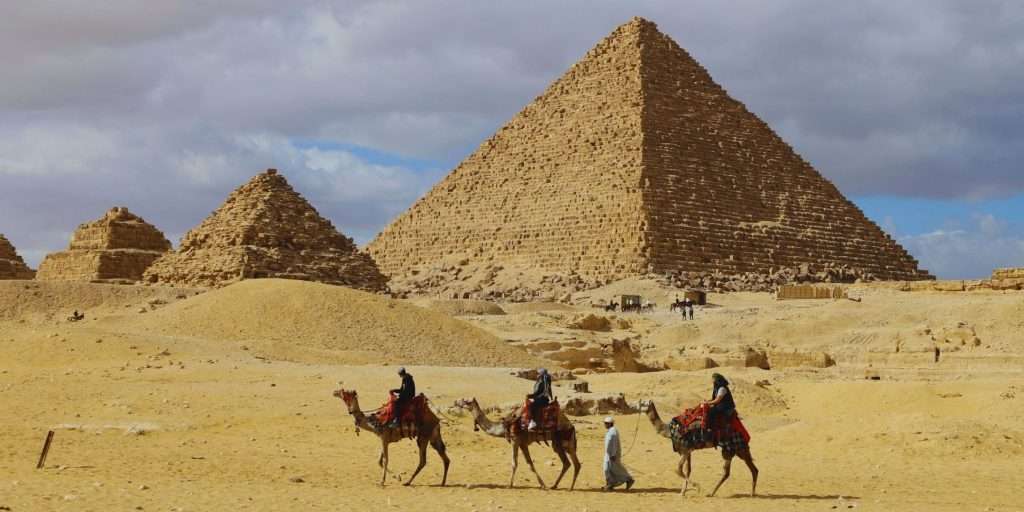
– The Great Pyramids of Giza (Egypt).
– The Colossus of Rhodes (Greece).
– The Hanging Gardens of Babylon (Iraq).
– The Lighthouse of Alexandria (Egypt).
– The Mausoleum of Helicarnassus (Turkey).
– The Statue of Zeus (Greece).
– The Temple of Artemis in Ephesus (Turkey).
If you know your world landmarks, you’ll already be aware that only one of these has survived to the present day: Giza’s Great Pyramids. But it’s also worth considering how myopic the Greeks were being. For centuries, it was being quietly but persistently drummed into people that the only part of “the world” that contained its most impressive landmarks – and thereby, the argument incorrectly went, its most noteworthy and advanced cultures – was a part of the Western Mediterranean that overlapped with the Middle East. Anywhere else? Nah, not worth bothering with.
Unsurprisingly, there have since been a number of attempts to topple this mighty edifice of well-meaning snobbery – and broadly speaking, modern lists are now firmly split between the natural and the human-made.
In 1994, the American Society of Civil Engineers released their “Civil Engineering Wonders Of The World” to celebrate buildings built for a practical purpose as much as a display of technical ingenuity. As a guide to some truly spectacular modern architecture, it still holds up well:
– The Channel Tunnel (England/France)
– The CN Tower in Toronto (Canada)
– The Empire State Building in New York (United States)
– Golden Gate Bridge (San Francisco)
– Itaipu Dam (Brazil/Paraguay)
– Netherlands North Sea Protection Works (Netherlands)
– Panama Canal (Panama).
If your tastes run more to the historical, the list created by the Swiss corporation New7Wonders Foundation (established in 2001) should suit you nicely. From a selection of 200 candidates, online polls and selection panels spent 6 years whittling down the list down to the following seven currently-existing monuments, with the Giza Pyramids added as an honorary candidate:
– Great Wall Of China (China)
– Petra (Jordan)
– The Colosseum of Rome (Italy)
– Chichén Itzá of Yucatán (Mexico)
– Machu Picchu (Peru)
– The Taj Mahal (India)
– Christ The Redeemer of Rio de Janeiro (Brazil)
That same organisation then did the same for natural landmarks, collecting over 100 million online votes from the public between 2007 and 2011 to settle on the following selection:
– Amazon Rainforest (Brazil, Bolivia, Colombia, Ecuador, French Guiana, Guyana, Peru, Suriname, Venezuela)
– Hạ Long Bay (Vietnam)
– Jeju Island (South Korea)
– Iguazú / Iguaçu Falls (Argentina/Brazil)
– Puerto Princesa Subterranean River National Park (Philippines)
– Komodo Island National Park (Indonesia)
– Table Mountain National Park (South Africa)
Not to be outdone – and no doubt because they saw how much attention these kinds of competitions were driving on the internet – another company sprang to life in 2008, aptly named Seven Natural Wonders, to promote its own list…which just so happened to be identical to one published by CNN in 1997:
– Aurora Borealis (aka. The Northern Lights)
– Grand Canyon (United States)
– Great Barrier Reef (Australia)
– Harbor of Rio de Janeiro (Brazil)
– Mount Everest (China / Nepal)
– Parícutin (Mexico)
– Victoria Falls, (Zambia/Zimbabwe)
So – what does this all mean? Is that 35 places you HAVE to go as soon as possible, as the most forceful online list-writers would have you believe? Are you profoundly missing out, if you decide to go elsewhere? Where would you even start? It’s a lot of pressure.
Maybe this will help:
It’s worth pausing for a minute to consider how utterly marvellous this moment in time is, when it comes to travel. If you had the free time and money, you really could spend all of 2025 visiting every wonder on all these lists. I’m not claiming it would be fun, of course – that would be the kind of crazy schedule that would wear down even the hardiest world traveller – but technically speaking, it could be done. A hundred or even fifty years ago, it’d be a logistical nightmare – or even just plain impossible.
From this perspective, and if circumstances and available resources aligned, you have the freedom to go anywhere. Isn’t that an absolute “wonder of the world” in itself? Or rather, of your world? Your ability to go to these places – in a way that previous generations of travellers absolutely couldn’t – is a marvel that’s well worth appreciating properly, and belongs at the top of your list.
Of course, it’s also just potential energy right now. You have to do something with it, to release its true power. So – what’s item 2 on the list you have already started ticking off? And hey, since this is now your list, you get to decide what’s on it, not some ancient Greek chap or lengthy public vote. You can choose anywhere in the world that is so meaningful to you that you want to go there as soon as possible!
So, where’s next?
Maybe we can give you a few ideas!