
“Um – shouldn’t this be in the fridge?”
My partner looks at what I’m pointing at: a roughly 2kg hunk of ham, still on the bone and propped up by some kind of wooden frame, resting on her kitchen sideboard.
“No, it’s fine.”
It certainly doesn’t look fine. There’s visible mold on the outside of the ham.
“But – it’s meat. How long has it been there?”
“Oh, about…hmm…3 months?”
“WHAT? UNREFRIGERATED? And is that what we had for lunch? Isn’t this exactly how food poisoning works? Should we go to the hospital?”
As a Brit, this horrified me to my core. Even now, after I’ve learned all the facts and about how safe and commonplace it is within Spain and often outside it, I still flinch. I know, deep in my bones, that when the weather warms up, food spoils quicker, so you need to cool or freeze it. That’s just how the world works.
But my partner’s leg of jamón serrano is showing me how much more I have to learn. It’s not just the temperature – it’s also about the humidity. Remove the moisture from vegetables, fruits or meats by some means (home food dehydrators are increasingly common) and you’ll massively extend their shelf-life, whether they’re refrigerated or not.
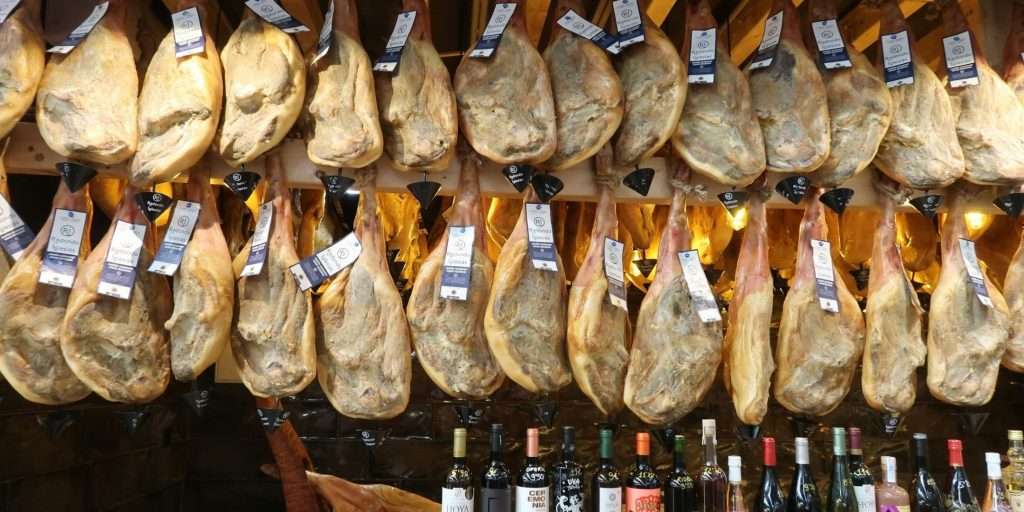
The easiest and therefore oldest method of dehydration is salting or curing. Most living things on earth have a maximum level of salt they can endure before it becomes toxic to their biology, which means if you salt something enough, it’ll kill the bacteria that eventually makes that food decay – and on top of that, salt is also great at absorbing moisture, so a coating of it will suck the water out of food until it’s almost entirely confined to its surface, where it’s vulnerable to being evaporated away.
This is the principle behind Spain’s famous varieties of jamón. They’ve been salted and dried in a way that seems (to me at least) to confound the laws of physics. If my partner’s jamón has been open for 3 months, it might only be halfway through its room-temperature shelf-life.
While we’re at it: that’s just “jamón”, by the way, not “jamón ham” (which will make Spanish people roll their eyes in the same way Indians would if someone says “chai tea”).
If you’re buying a hind leg of jamón serrano – it’s almost always a hind leg, because forelegs are labelled “paletilla” – you should know that it’s been on a remarkable journey. Putting aside the pig’s hopefully well-fed and stress-free life (and since this food is such a delicacy, that’s probably going to be the case), the fresh ham will have been buried in salt for 2 weeks where its flavour will intensify, then thoroughly washed to remove as much salt as possible, hung to dry somewhere with carefully controlled temperature and humidity levels for at least 6 months, and then moved to a cool and equally dry place where it’s left to mature for anything from 9 months to 3 years.
(The maturation time for jamón iberico – the other main commercial label that’s mostly produced from the black Iberian pig – is often much longer, which is why it’s usually more expensive, and therefore a frequent target for thieves.)
The result of this elaborate preservation process, even before you start slicing into it, is a ham that’s already more than a year old – and that’s all without refrigeration.
This should explain its appearance. While the inside of the jamón retains enough salt to fend off bacteria, the washed outside (which nobody eats) might be mottled with a few shallow patches of mold, in a way that can look less than appealing. (But then, you might have seen cheeses that look far worse! It’s one of those aspects of matured food that’s worth getting used to, because of the flavours that accompany it – and it’s also a sign it’s been properly aged, so you’re getting your money’s worth.)
The bone is also important here. If the leg is displayed on a jamonero (a wooden rack) specially designed to prop up the entire ham for easy slicing, the layer of fat on the outside will protect the meat from spoiling. But if you slice it up into strips, you’re removing the protections given by the fat and the bone and you’re exposing the meat to the open air – which means that yes, now it needs to be stored in a fridge or freezer, since it will be subject to all the normal rules of food decay.
If you do decide to slice it up, don’t be tempted to give the bone to your dog. Alas, it’s far too salty. The best thing to do with it is cook up some bone broth or slice up the meatiest parts of it to put in a stew.
If you’re convinced that you want to give all this a try for yourself, here’s a critical detail I left out. My partner’s flat was in Barcelona. While it’s possible to travel within the EU with vacuum-packed jamón, you’ll probably be out of luck elsewhere, including with Canada, where fresh, cured and dried meats of all kinds are not permitted in your travel luggage.
So here’s my suggestion for a gastronomic adventure: if you like your cured meats (and honestly, jamón is the king of them), then take a trip to Spain that’s at least a couple of weeks long, and buy yourself a whole jamón to snack upon and supplement your meals the whole time you’re there. It’ll feel strange, you may occasionally horrify the odd fellow traveller, but there’s nothing more Spanish you could be doing while you’re there. ¡Ole!
This October, join us on a 15-day adventure exploring Spain’s Andalusia region. Begin in Madrid, spend three nights in Seville, dive into the cultural richness of Córdoba for four nights, enjoy six extended nights in Malaga, and conclude the expedition with a final night in Madrid, cherishing memories of an unforgettable trip through Andalusia’s beating heart. Secure your place here.