
It’s the first day of the Scottish winter, with a bone-chilling cold that’s sweeping down from the Arctic – and here I am, getting emotional over a potato.
It’s not like the winter has this effect on me. I’m from the north of England, so I’m used to a bit of bad weather – welcome it, even. (There’s nothing quite like going for a walk in the rain when you’re wearing the right clothing for it.)
But this potato has got to me. It’s on display outside my local greengrocer’s, perched on top a pile of bagged kilo-weight bundles of the same variety, all of them matted with clumps of soil.
If you’re a gardener, you know there’s something a bit special about a potato with some of the soil still stuck on it. You can crumble it between your fingers, take a sniff and fill your nostrils with the heady aroma of good, clean earth, so similar to that delicious scene coming from the ground after it rains. (That’s called petrichor, by the way, and it’s how a camel locates an oasis in the high desert.)
Stuck to this potato, in thick, compact lumps, is red soil. That immediately gives the game away – there’s nowhere in the UK where potatoes are commercially grown in red soil, and certainly not with this amount of clay in it. Some rain has gusted in so the potato’s damp, and the red clay smears as I rub at it, in a way that triggers childhood memories of washing vegetables in the sink when I was a boy living in the Mediterranean.
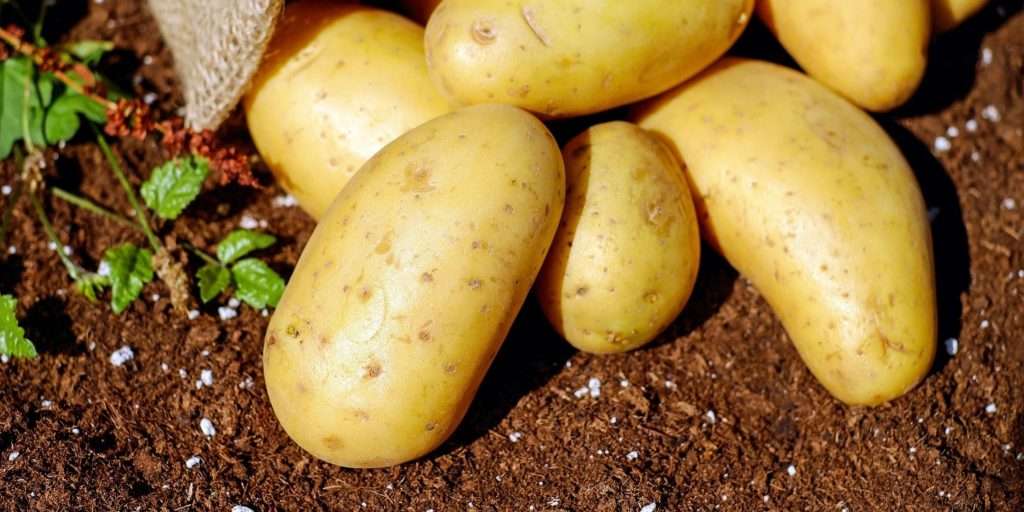
This, I realise with a rush of emotion, is Cyprus, my childhood home. That’s where this potato was dug out the ground, that’s what is stuck to the side of it in red lumps – and somehow it’s made its way nearly 4,000 kilometres to the north of Europe, where it’s just quietly sitting here with no sense of drama about it, as if it’s not some vegetable version of Odysseus.
Get a grip, Mike, a voice says in my mind. It’s just a potato.
But it’s not. For starters: isn’t it amazing how our food does this? How it can travel vast distances to grace our dinner tables? As much of a fan of seasonal fare as I am, it is also nice, just as a treat, to be able to sample a flavour from another part of the world, especially when you don’t have any imminent travel plans. And in this case, it’s also the power to enjoy a flavour you associate with a particular time and place in your life.
(In my case, it was with the sun beating down on my long-gone blond curls, the ground too hot to walk barefoot, every olive tree a source of delicious shade, and all the nostalgia of a childhood spent in the Mediterranean in weather so reliably glorious that when five years later my parents relocate us back to England and we land at Heathrow airport, I look out the plane window and angrily say to them, “Why have we come here? It’s raining!”)
But these are also special potatoes in their own right. I am deeply impartial as a judge, but for me, one of the best reasons to visit Cyprus is to be able to wander into a taverna and order a big plate of Κυπριακες Πατατες στο Φουρνο (Cypriot Baked Potatoes). It’s a simple dish where you put peeled & roughly chopped potatoes in a pan, chuck in some onion, tomato, oregano and salt, nearly submerge them in lemon juice and strong, peppery olive oil, then roast everything for 90 minutes. The result is truly heavenly. Words fail me.
That mind-blowing taste is mostly down to the potatoes themselves. They’re grown in a special area known as the Red Villages (Avgorou, Ormidia, Dasaki Achnas, Xylofagou, Frenaros, Sotiras, Paralimni, Vrysoulles, Liopetri, Deryneia, Ayia Napa and Protaras). The soil surrounding them is red with clay and alluvium – material deposited by a river – and it’s richly fertile, making it ideal for growing artichokes, citrus and potatoes, which are harvested in the summer for storage and export as the seasons turn cooler.
What this means in practice is vegetables with a really special taste and feel – becoming crispy on the outside and soft & buttery in the middle, much softer and fluffier than the sturdier northern European varieties, but with the same kind of mineral, peaty earthiness you’ll get from a fine Scotch, nicely set off with the faintly bitter tang of the oregano and lemon juice.
In my experience both as a child and an adult, Cypriot food ranges from pretty great to something on the level of a religious experience – and it’s for that reason that I’d recommend to anyone that they stay on the island at least half a month, to give yourself at least a couple of dozen chances to eat your way around the menu.
(Wheel and Anchor feels the same way, which is why it’s running two ‘LiveAway’ programmes this coming March, each lasting a couple of weeks.)
My only advice to them here is to not be afraid of the simplest-looking dishes, including if they go out for a meze (“the meal with nothing on the menu”). Yes, it may look like just an everyday plate of roast potatoes – but it’s going to taste like nothing you’ve ever encountered before because of the earthy magic infused into those ingredients, and years later, you might even get a bit emotional at the memory of it. It’s certainly been known to happen.
Join Wheel & Anchor in March 2025 to explore ‘The Island of Love’ – the cultural crossroads of the Mediterranean, Cyprus. A popular sun destination for Europeans, this gem is less-visited by Canadian travellers. Come with us to discover its fascinating history and outstanding cuisine with influences from the Greeks, Turks, Arabs, and more. Get the details here.